

We have a growing collection of databases and resources to help you cover — and uncover — great stories on your national security beat. Here is an overview of some of the data sets we build and analyze. More will be coming as 2013 unfolds.
Airport Gun Confiscations
A database built from weekly details released by the Transportation Security Administration about guns confiscated at airport check-in. Included is data by incident, day and by airport; type of weapon; whether it was loaded or not; and if loaded, whether there was a bullet in the chamber. There are also monthly and other charts. Data covers 2012 and 2013 to date. Available for download as CSV file. → Full Details.

Government requests for online user data
Online privacy is a skyrocketing national security issue. Google, Twitter, Microsoft, Facebook, Apple and others now regularly release detailed databases about requests from governments for user information and data (the U.S. is by a long-shot the world leader in pursuing subpoenas and search warrant for the personal information). The most recent addition to these reports is data about the number of National Security Letters received and reports released after the Justice Department in January relaxed its reporting restrictions and allowed data on National Security orders. We don’t duplicate the databases that Google, Twitter and Microsoft maintain, but we do regular analysis (see archive of stories on our On the Beat blog).
- At your fingertips: A list of links to all major companies’ reports.
- AT&T latest company to report number of FISA requests and National Security Letters under new reporting rules.
- More companies report under loosened rules on national security orders for customer info
- Facebook makes its first revised report on U.S. government’s secret requests for user data
- Apple first to report number of secret customer data requests under new reporting rules.
- For Verizon, a solid grade on transparency reporting.
- Government requests for data about Google users doubled since 2010.
- Microsoft got 44 requests for data a day from US agencies in first half of 2013
- Apple joins peers in sharing data about government requests for data.
- U.S. government asked to snoop on 40,000 Yahoo accounts in first half of year
- Facebook in its inaugural transparency report says it rejected 20% of government data requests.
- U.S. government requests for user data from Twitter up 11% in first half of year.
- A table summarizing law enforcement data requests from major online companies.
- Google Transparency Report
- Download Google data
- Twitter Transparency Report
- Twitter data
- Microsoft’s Law Enforcement Requests Report
- National Security Letters data now released with transparency reports.
- US leads in share of internet users for which it asks Google for account data.
- FISA requests up in 2012 while number of NSL letters issued down a bit.

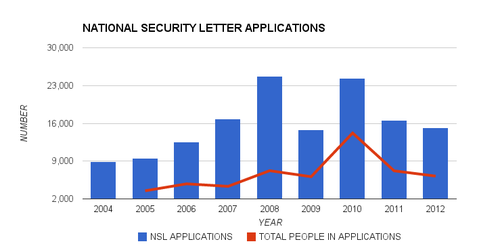
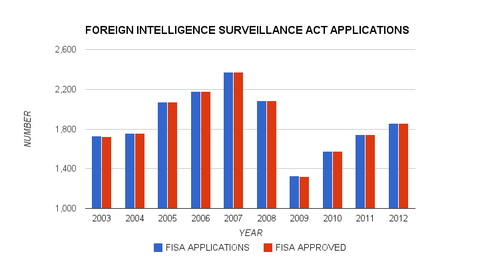 SOURCE: OnTheBeat graphics using EPIC.org compilation from Federation of American Scientists document collection.
Homeless Veterans
The federal Department of Housing and Urban Development’s annual update on the state of homelessness in the country was released in late November, 2013 and showed continued progress in shrinking the number of homeless veterans in the past few years.
But like all such reports, the overall trend varies from state to state and city to city. To help you dig through and find those differences, we’re extracted the veteran’s section of the 2013 Annual Homeless Assessment (view it here), and include links below to spreadsheets with state data going back to 2007.
- Spreadsheets 2007-2013 by state and local areas.
- PDF reports by state, local area and by year.
- Full homeless report (PDF)
Bear in mind that these are not the definitive counts on the homeless or homeless veterans, and be sure to check the updated reports for each year, some of which include adjustments that HUD has made to supplement the one-night counts that are the foundation for the report. (Example: Look at Page 5 in the supplemental report here.)
Military Suicides

2012 was a record year for suicides in the U.S. Military. We’ve begun compiling monthly totals that the Army, Navy and Marines release. The Army, which has the highest number of suicides, has the most detailed data. We also have full month-by-month 2012 and 2013 data, as well as historic totals, along with links to Department of Defense annual reports that have a very detailed amount of data. → Full Details.
Chart below shows potential suicides, by month, for the U.S. Army in 2013. In its monthly updates, the Army adjusts data from earlier months to reflect whether a potential suicide has been confirmed or is still under investigation. Potential suicides=confirmed+under investigation. View and download the data.
Unemployed Veterans
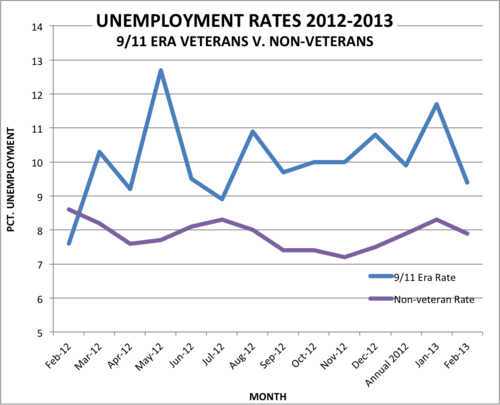
- Not much progress in 2013 for unemployed Gulf War II era veterans
- Post-9/11 veterans unemployment dips, but still 25% higher than non-veterans
- Our latest stories on unemployment among veterans, particularly the 9/11-era cohort.
- Analyze and download data that National Security Zone compiles from Bureau of Labor Statistics and other sources.
- Extract your own veteran-related unemployment data from the BLS.
- Archive of monthly data press releases, including all tables.
Analyzing your data

It’s one thing to lead you to data; it’s another for you to take charge and mine for your own stories. We’ve got two of our “NSZ 101” how-to guides that will help.
In Part I, Brendan McGarry of Bloomberg takes you through the basics of using an Excel spreadsheet to analyze an example data set of U.S. military deaths. You’ll learn how to calculate differences, percentages and rates; add numbers in columns, compare parts to a sum, and sort the data.
In Part II, McGarry walks you thorough filtering, creating subtotals and pivot tables and creating graphs and charts.

VA Disability Claims Backlog
The Veteran’s Administration has a mountainous backlog of disability claims waiting to be processed and concedes it probably won’t make much headway until 2015 at least in reducing it. This is a significant story, of course, for these veterans, their families, and the communities in which they live.
We’ve assembled a selection of resources to help you cover this issue on a local, regional or national basis. Much of what we present comes from the staff over at the Center for Investigative Reporting, which has done yoeman’s work staying on top of this issue, along with gathering a pile of data and creating a pile of code that makes it all broadly available.
- A chart and graphics, updated weekly, with the latest on progress in reducing the backlog. Based on data from the VA’s “Monday Morning Workload Reports.” View the archive.
- Dashboard with various items, including the map below.
- Interactive charts with the claims processing status for all cities with a VA processing center.
-

